California Real Estate Exam Pass Rate: What the Numbers Tell You
Why does California's real estate exam have a ~54% pass rate — and what does that mean for your preparation strategy?
If you've done any research on the California real estate exam, you've probably come across the pass rate statistic: roughly 54% of first-time test-takers pass. That means nearly half of everyone who sits down to take this exam walks out without a license.
At first glance, that sounds scary. But once you understand *why* people fail, it becomes a lot less intimidating — because the reasons are almost entirely avoidable.
What the Pass Rate Actually Means
The California DRE publishes pass rate data regularly. The salesperson exam consistently sees pass rates between 50–58% depending on the year and testing period. The broker exam is harder — typically 45–55%.
Here's the critical context: the pass rate includes everyone, including people who:
- Barely studied or only read the textbook without practicing questions
- Took the exam before finishing their pre-license courses
- Showed up to "see what it's like" without serious preparation
- Took it a second, third, or fourth time (repeat takers are included in the stats and lower the overall rate)
- Took the exam years after completing their courses, with knowledge faded
Among people who genuinely prepare — completing 500+ practice questions, taking mock exams, and systematically reviewing weak spots — the pass rate is substantially higher. The exam rewards preparation disproportionately.
How Pass Rates Break Down
The DRE doesn't publish data on first-time vs. repeat takers separately, but industry analysis suggests:
- Prepared first-time takers (500+ practice questions, mock exams): estimated 70–80% pass rate
- Unprepared first-time takers (textbook only or minimal prep): estimated 35–45% pass rate
- Repeat takers (second attempt): pass rates similar to or slightly higher than first-timers
- Multiple repeat takers (three or more attempts): generally lower rates, often indicating a need to change preparation strategy
The headline number — 54% — averages everyone together. It tells you the exam requires real preparation. It doesn't tell you much about your odds if you actually prepare.
Why Do People Fail?
After analyzing common failure patterns, the reasons are consistent:
1. Insufficient practice questions
Most people who fail spent their time reading the textbook instead of answering questions. The exam tests application of knowledge, not memorization. If you haven't practiced applying concepts to scenario-based questions under time pressure, you'll struggle even if you "know" the material.
The fix: Do a minimum of 500 practice questions before exam day. Aim for 700–1,000 if time allows.
2. Neglecting real estate math
Real estate math shows up in 10–15% of questions — that's 15–22 out of 150. Many test-takers skip math preparation entirely, then get decimated on exam day. The math isn't hard — it requires knowing the formulas and practicing them. Commission calculations, LTV ratios, cap rates, prorations — all are formulaic once you know the pattern.
The fix: Spend at least 2–3 dedicated study sessions on math formulas and do 50+ math practice problems.
3. Underestimating California-specific material
The California exam includes material specific to California law, the DRE, trust fund handling, and disclosure requirements. Test-takers who study generic national content without focusing on California-specific rules are consistently caught off guard.
The fix: Pay special attention to mandated disclosures (TDS, NHD, lead paint), trust fund rules (3-business-day deposit), agency disclosure requirements, and DRE regulations.
4. Test anxiety and time pressure
150 questions in 3 hours is 72 seconds per question. That's enough time if you're prepared, but if you spend 5 minutes on one question, you'll run out of time. People who haven't practiced under timed conditions often panic when the clock is running.
The fix: Take at least 2 full mock exams under timed conditions. Simulate the real thing completely — no breaks, no phone, 3 hours straight.
5. Not reviewing explanations
Getting a practice question right doesn't mean you understand it. Getting one wrong and not reading the explanation is an even bigger mistake. Every question you practice should teach you something.
The fix: Read every explanation for every practice question, right or wrong. Pay special attention to questions you got right by guessing.
How Pass Rates Compare to Other States
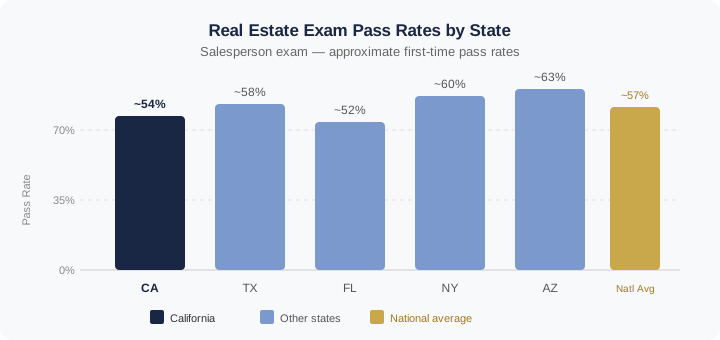
California's exam is considered one of the more rigorous state real estate exams. For comparison:
- California salesperson: ~54%
- Texas: ~57–60%
- Florida: ~50–55%
- New York: ~60%
- Arizona: ~60–65%
- National average: ~55–60%
California is on par with or harder than most states. The depth of California-specific content — the DRE structure, disclosure requirements, trust fund rules, and agency law — makes it more material-intensive than many national exams.
Does It Get Easier on Retakes?
Somewhat — but only if you change your preparation strategy.
Repeat test-takers who had a genuine study strategy the first time (but had a bad day or missed a few key topics) tend to pass on their second attempt. They know what to expect, they know their weak spots, and they go in more confident.
People who just show up again without changing their preparation approach often fail multiple times. The exam doesn't get easier by familiarity alone.
If you're retaking: Use your first exam as data. Recall which topic areas felt shakiest. Focus your retake preparation there. Take 2–3 mock exams before going back.
DRE retake policy: You can retake the salesperson exam as many times as needed. There's a waiting period after each failed attempt (18 days after a first failure), and you'll pay the exam fee again ($100 for salesperson, $150 for broker). There's no limit on the number of attempts.
The Honest Truth About Failing
Failing the California real estate exam doesn't mean you're bad at real estate or shouldn't get a license. It almost always means one of two things:
- You didn't practice enough questions
- You had gaps in specific topics (usually math, agency, or California-specific rules)
Both of those are fixable. The people who pass on the first try aren't necessarily smarter — they just prepared more systematically.
What This Means for Your Strategy
The 54% pass rate tells you this exam requires real preparation. But it also tells you that more than half of all test-takers — including many who aren't especially well-prepared — manage to pass. If you prepare properly, your odds are significantly better than the headline number suggests.
The path to passing on your first attempt:
- Complete your 135 hours of pre-license education
- Answer at least 500 practice questions before exam day, organized by topic
- Take 2–3 full mock exams under timed conditions
- Focus extra time on math and California-specific content
- Review every wrong answer — and many right ones — in detail
Start with our free quiz at CARealestate.com to get a baseline on where you stand — no signup required.
Ready to practice for the California exam?
25 free questions — no signup needed. Unlock 500+ with a plan.
Exam Study Resources
Free tools to help you pass on the first try.
More California Study Guides
Related articles to help you pass on the first try.