California Real Estate Exam Topics: Complete Breakdown (2026)
Exactly what's on the California DRE salesperson exam — topic-by-topic with percentages, key concepts, and what to study first.
The California DRE salesperson exam tests seven major topic areas. Knowing exactly what percentage each topic carries — and which subtopics appear most often — is the difference between scattershot studying and targeted preparation.
This breakdown is based on the official DRE examination content outline.
The 7 Topic Areas at a Glance
The exam has 150 questions. Here's how the DRE allocates them:
- Practice of Real Estate and Mandated Disclosures — 25% (~37 questions)
- Laws of Agency and Fiduciary Duties — 17% (~25 questions)
- Property Ownership and Land Use Controls — 15% (~22 questions)
- Property Valuation and Financial Analysis — 14% (~21 questions)
- Financing — 13% (~19 questions)
- Transfer of Property — 8% (~12 questions)
- Contracts — 8% (~12 questions)
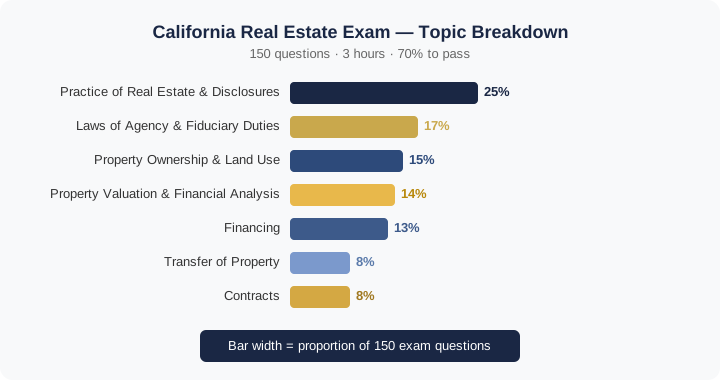
With 150 questions, getting weak on any single section costs you significantly. If you score only 50% on Practice of Real Estate (25%), you've lost roughly 19 questions — nearly half your allowed misses.
1. Practice of Real Estate and Mandated Disclosures (25%)
This is the largest section and the most California-specific. It covers the day-to-day reality of working as a licensed agent under DRE oversight.
Mandated Disclosures
California requires agents and sellers to disclose a wide range of information. The most tested ones:
- Transfer Disclosure Statement (TDS) — Required for virtually all 1–4 unit residential sales. Seller must complete it; agent must inspect and note visible defects.
- Natural Hazard Disclosure (NHD) — Required statewide; discloses whether the property is in a flood zone, fire zone, earthquake fault zone, seismic hazard zone, or wildland fire area.
- Lead-based paint disclosure — Required for homes built before 1978. Buyer must receive EPA pamphlet and have 10 days to inspect.
- Megan's Law database disclosure — Sellers must advise buyers to check the state sex offender database.
- Military ordnance disclosure — Required if the property is within 1 mile of a former federal or state military base.
- Methamphetamine contamination — If seller knows of prior contamination, must disclose.
Trust Fund Handling
This is one of the most tested subtopics on the entire exam:
- Brokers must deposit trust funds within 3 business days of receipt
- Commingling = mixing client funds with personal/business funds (prohibited)
- Conversion = using client funds for personal use (a crime — grounds for license revocation and potential criminal charges)
- Broker must maintain complete trust fund records
- Advance fees paid to brokers must be deposited in trust unless the DRE approves otherwise
DRE and Licensing
- The California Department of Real Estate (DRE) is the state regulatory body
- The Real Estate Commissioner is appointed by the Governor and heads the DRE
- The Commissioner can issue, suspend, and revoke licenses; cannot set exam fees or commission rates
- Salesperson license requires: 18 years old, 135 hours pre-license education, pass the exam, pass a background check
Advertising Rules
- Advertising must include the broker's name (not just the agent's)
- "Blind ads" (ads that don't identify the advertiser as a broker or agent) are illegal
- All material facts must be disclosed; misrepresentation in advertising is grounds for disciplinary action
2. Laws of Agency and Fiduciary Duties (17%)
Agency law governs the legal relationship between agents and their clients. It's heavily tested because it defines core professional obligations.
Types of Agency
- Seller's agent (listing agent) — owes full fiduciary duties to the seller
- Buyer's agent — owes full fiduciary duties to the buyer
- Dual agent — represents both buyer and seller in the same transaction; legal in California with written informed consent from both parties
- Subagent — a licensee who works under another broker to assist the client
Fiduciary Duties: OLD CAR
Every California real estate agent must know these six duties:
- Obedience — Follow all lawful instructions from the client
- Loyalty — Put the client's interests above your own and everyone else's
- Disclosure — Reveal all material facts that would affect the client's decision
- Confidentiality — Protect the client's sensitive information (e.g., motivation to sell quickly, maximum price they'll pay)
- Accounting — Account for all funds and property entrusted to you
- Reasonable care — Provide competent, professional service
Agency Disclosures
California requires specific written disclosures about agency relationships:
- The "Disclosure Regarding Real Estate Agency Relationships" form must be given to buyers and sellers before they sign any agreements
- Listing agent gives it to seller before or at the time of signing the listing agreement
- Buyer's agent gives it to buyer before writing an offer
- In a dual agency situation, both parties must give written informed consent
What Dual Agency Limits
In dual agency, the agent cannot: - Disclose the seller's minimum acceptable price to the buyer - Disclose the buyer's maximum willingness to pay to the seller - Advocate for one party's interests over the other
3. Property Ownership and Land Use Controls (15%)
This section covers how property can be owned, used, and regulated.
Types of Ownership
- Severalty — Sole ownership; one person owns the property outright
- Tenancy in common — Two or more owners; each has an undivided interest; interests can be unequal; NO right of survivorship; interest passes through will or intestate succession
- Joint tenancy — Two or more owners with equal shares; requires the four unities (TTIP: Time, Title, Interest, Possession); includes the right of survivorship — when one dies, their share passes automatically to surviving joint tenants
- Community property — California's default for married couples; each spouse owns 50% of assets acquired during marriage; either spouse can will their half
- Community property with right of survivorship — Like community property but adds the right of survivorship
Zoning and Land Use
- Zoning classifies land as residential, commercial, industrial, or agricultural
- Variance — Permission to deviate from specific zoning requirements (e.g., setback) due to unique hardship; does NOT change the zoning
- Conditional use permit (CUP) — Allows a use that isn't normally permitted in a zone (e.g., a church in a residential zone)
- General plan amendment — Changes a city's long-range planning document; takes longer and is more difficult than a variance
Easements
- Easement appurtenant — Benefits a neighboring property (dominant estate); runs with the land
- Easement in gross — Benefits a person or entity (e.g., utility easement); doesn't require a dominant estate
- Prescriptive easement — Acquired through continuous, open, hostile, notorious use (without permission) for 5 years; unlike adverse possession, no tax payment required
- Easement by necessity — Created when a property has no access to a public road
Liens
- Voluntary liens — Created by the property owner (e.g., mortgage, deed of trust)
- Involuntary liens — Created by law without the owner's action (e.g., property tax lien, mechanic's lien)
- Lien priority — Generally determined by recording date; property tax liens take priority over all others
4. Property Valuation and Financial Analysis (14%)
Appraisers and agents use three approaches to estimate value. Know when to use each one.
Three Appraisal Approaches
- Sales comparison approach — Best for residential property; compares subject property to recent sales of similar properties (comparables), with adjustments for differences
- Cost approach — Best for new construction or special-use properties (schools, churches); estimates Land Value + Replacement Cost − Depreciation
- Income approach — Best for income-producing properties (apartments, commercial); uses Net Operating Income (NOI) and capitalization rate
Income Approach Formulas
- NOI = Gross Potential Income − Vacancy & Credit Loss − Operating Expenses
- Cap Rate = NOI ÷ Value
- Value = NOI ÷ Cap Rate
- GRM (Gross Rent Multiplier) = Price ÷ Monthly Rent
Types of Depreciation
- Physical deterioration — Wear and tear; can be curable (deferred maintenance) or incurable (structural issues)
- Functional obsolescence — Outdated features (e.g., only one bathroom in a 5-bedroom home); can be curable or incurable
- External/economic obsolescence — Caused by factors outside the property (e.g., new highway next door, declining neighborhood); always incurable
5. Financing (13%)
This section covers mortgage types, lending laws, and key financial concepts.
Loan Types
- Conventional loans — Not government-backed; typically require 20% down to avoid PMI
- FHA loans — Government-backed; lower down payment (3.5%); requires mortgage insurance premium (MIP)
- VA loans — For eligible veterans and active military; no down payment required; no PMI
- USDA loans — For rural properties; low or no down payment
Key Concepts
- LTV (Loan-to-Value) = Loan Amount ÷ Property Value
- Points — Prepaid interest; 1 point = 1% of the loan amount; discount points lower the interest rate
- Amortization — Process of paying off a loan through regular payments covering both principal and interest
- Adjustable Rate Mortgage (ARM) — Rate changes periodically based on an index; typically has a lower initial rate than fixed-rate
Federal Lending Laws
- RESPA — Prohibits kickbacks between settlement service providers; requires Loan Estimate and Closing Disclosure
- TILA — Requires disclosure of APR; gives borrowers a 3-day right to rescind certain refinance transactions
- ECOA — Prohibits lending discrimination based on race, sex, religion, national origin, age, marital status, or receipt of public assistance
- HMDA — Requires lenders to collect and report data on mortgage applications
6. Transfer of Property (8%)
Types of Deeds
- Grant deed — California's most common deed; implies two warranties: grantor hasn't previously conveyed the property, and no undisclosed encumbrances
- Quitclaim deed — Conveys whatever interest the grantor has (if any) with no warranties; often used to clear title issues
- Warranty deed — Provides the broadest protection; grantor guarantees title against all defects, even those created before the grantor's ownership
Adverse Possession
To claim title through adverse possession in California: - Use must be open and notorious (visible, not hidden) - Use must be continuous for 5 years - Use must be hostile (without the owner's permission) - Claimant must pay property taxes during the period
Probate and Intestate Succession
When someone dies without a will (intestate), their property passes according to California's intestate succession laws. The surviving spouse typically inherits community property; separate property follows a different distribution based on surviving relatives.
7. Contracts (8%)
Essential Elements (CLOCA)
For a real estate contract to be valid:
- Consideration — Something of value exchanged by both parties
- Legal purpose — The contract cannot require illegal acts
- Offer and acceptance (mutual agreement) — A definite offer and an unequivocal acceptance
- Capacity — Parties must be of legal age (18+) and mentally competent
- Agreement in writing — Per the Statute of Frauds, real estate contracts must be in writing
Contract Status
- Valid — Meets all requirements; enforceable by both parties
- Void — Has no legal effect from the start (e.g., illegal purpose)
- Voidable — Valid but can be canceled by one party (e.g., signed under duress, signed by a minor)
- Unenforceable — Valid but cannot be enforced in court (e.g., not in writing)
Study Priority Recommendations
Given the topic weights, here's how to allocate your study time:
- Practice of Real Estate & Disclosures (25%) — Highest impact; most California-specific
- Agency & Fiduciary Duties (17%) — Very frequently tested; know OLD CAR cold
- Property Ownership & Land Use (15%) — Heavy on memorization; flashcards help
- Property Valuation & Financial Analysis (14%) — Requires formula practice
- Financing (13%) — Many federal law questions; know RESPA, TILA, ECOA
- Transfer of Property (8%) — Focused topic; learnable quickly
- Contracts (8%) — Core concepts; watch the void vs. voidable distinction
Use our topic-by-topic quiz at CARealestate.com to measure your performance in each area and identify exactly where to focus your remaining study time.
Ready to practice for the California exam?
25 free questions — no signup needed. Unlock 500+ with a plan.
Exam Study Resources
Free tools to help you pass on the first try.
More California Study Guides
Related articles to help you pass on the first try.