How to Pass the California Real Estate Exam (2026)
The California real estate exam has a ~54% pass rate. Here's the exact study strategy that top scorers use to pass first time.
The California real estate salesperson exam is no joke. With a pass rate hovering around 54%, nearly half of all test-takers walk out without a license on their first attempt. But here's the thing: failing is almost always avoidable. The people who fail usually make the same handful of mistakes — and once you know what those are, you can sidestep them completely.
This guide covers exactly how to prepare so that exam day feels like a formality.
Know What You're Walking Into
The California DRE salesperson exam consists of 150 multiple-choice questions. You have 3 hours to complete it. To pass, you need to score at least 70% — meaning you can miss up to 45 questions and still get your license.
The exam is divided into seven official content domains. Here is the official breakdown from the California Department of Real Estate:
| Content Domain | DRE Weight | Questions (of 150) |
|---|---|---|
| Practice of Real Estate & Mandated Disclosures | 25% | 37–38 |
| Laws of Agency & Fiduciary Duties | 17% | 25–26 |
| Property Ownership & Land Use Controls | 15% | 22–23 |
| Property Valuation & Financial Analysis | 14% | ~21 |
| Contracts | 12% | 18–19 |
| Financing | 9% | 13–14 |
| Transfer of Property | 8% | ~12 |
Source: California DRE Salesperson Examination Content — dre.ca.gov/Examinees/SalesExamContent.html. Updated June 2026.
Practice of Real Estate & Mandated Disclosures is the heaviest domain at 25% — roughly 37–38 questions. Contracts ranks third by weight at 12%, but many study materials under-cover it. Financing accounts for only 9%, so don't over-rotate on mortgage math at the expense of disclosure and agency content.
The 4 Biggest Mistakes Test-Takers Make
Mistake #1: Only reading the textbook
Passive reading doesn't work for this exam. The DRE tests your ability to apply concepts, not recite definitions. You need to answer practice questions — lots of them. Reading about agency law is not the same as being able to answer a scenario question about it under time pressure.
Mistake #2: Skipping real estate math
Math questions make up roughly 10–15% of the exam. That's 15–22 questions. Many people skip math prep entirely, then lose a huge chunk of points on exam day. The math is not difficult — commission calculations, loan-to-value ratios, prorations, cap rates — it just requires practice with the right formulas. Once you know them, math questions become free points.
Mistake #3: Ignoring California-specific rules
The national real estate exam and the California exam are different animals. California has its own disclosure requirements, agency laws, and licensing rules. Study California-specific content carefully — especially the DRE, the Real Estate Commissioner, trust fund handling, and mandated disclosures like the Transfer Disclosure Statement and Natural Hazard Disclosure.
Mistake #4: Cramming the night before
This is a knowledge exam. Cramming doesn't stick. You need consistent study over 4–6 weeks to really internalize the material. People who try to compress everything into a week almost always fail. Space your study sessions out — your brain needs time to consolidate what it learns.
The Study Plan That Works
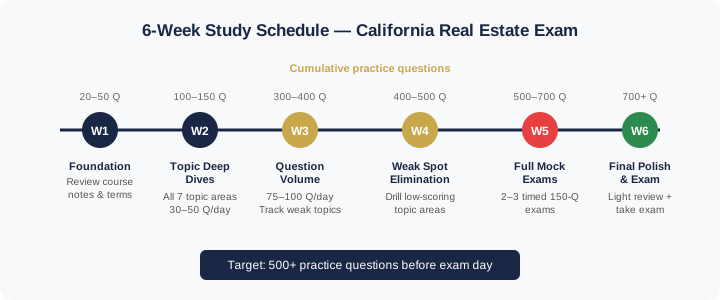
Weeks 1–2: Build the Foundation
- Complete your 135 hours of pre-license education if you haven't already
- Focus on Real Estate Principles and Real Estate Practice
- Read actively — take notes on key terms and concepts
- Don't skip sections that seem boring (trust fund handling, disclosure requirements) — they're heavily tested
- Make flashcards for key terms: fiduciary duties, types of agency, deed types, lien types
Weeks 3–4: Practice Questions by Topic
- Start doing practice questions organized by topic
- Aim for 50–100 questions per day
- Don't just check if you got it right — read every explanation, even for questions you got correct
- Track which topics you're weak on (agency, math, disclosures, contracts)
- Drill any topic where you're scoring below 70%
Week 5: Full Mock Exams
- Take at least 2–3 full 150-question mock exams under timed conditions
- 3 hours, no breaks, no phone — simulate the real thing as closely as possible
- Review every wrong answer in detail — understand why you got it wrong, not just what the right answer is
- If you're consistently scoring 75%+ on mock exams, you're ready
Week 6: Target Your Weak Spots
- Focus exclusively on the topics where you scored lowest
- Drill math formulas until they're automatic — write them out from memory
- Review California-specific rules one more time: disclosure requirements, trust fund rules, DRE regulations
- Take one final mock exam two days before your exam date
The Topics That Trip People Up Most
Agency and fiduciary duties — Know OLD CAR (Obedience, Loyalty, Disclosure, Confidentiality, Accounting, Reasonable care) cold. Understand the difference between listing agent, buyer's agent, and dual agent. Know what a dual agent can and cannot do. Understand when agency disclosure forms must be given.
Real estate math — Practice commission calculations, loan-to-value ratios, prorations, capitalization rates, and area calculations. These are formulaic — once you know the formula, they're reliable points. Key formulas: LTV = Loan ÷ Value, Cap Rate = NOI ÷ Value, Commission = Price × Rate.
Trust fund handling — California has strict rules about client funds. Know the 3-business-day deposit rule. Know what constitutes commingling (mixing client funds with your own) and conversion (using client funds for personal purposes). Both are grounds for license revocation.
Fair Housing — Know all seven federal protected classes (race, color, religion, sex, national origin, familial status, disability) plus California's additional protections (marital status, sexual orientation, ancestry, source of income, and more). Know the definitions of steering, blockbusting, and redlining.
Mandated Disclosures — The Transfer Disclosure Statement (TDS) is required for virtually all 1–4 unit residential sales. The Natural Hazard Disclosure (NHD) is required statewide. Lead-based paint disclosure is required for homes built before 1978. Know when each applies and to whom.
Liens and encumbrances — Know the difference between voluntary liens (mortgages) and involuntary liens (tax liens, mechanic's liens). Know lien priority rules. Know what homestead exemption does and doesn't protect.
California-Specific Rules You Must Know
These topics are unique to California and consistently tested:
The Real Estate Commissioner — Appointed by the Governor; heads the DRE; has the power to issue, suspend, and revoke licenses. Does NOT set exam fees (the Legislature does that).
License requirements — California requires 135 hours of pre-license education for salesperson candidates: Real Estate Principles (45 hrs), Real Estate Practice (45 hrs), and one elective (45 hrs). Minimum age is 18.
Trust fund rules — Brokers must deposit trust funds within 3 business days. Unauthorized withdrawal of client funds is a felony. Brokers cannot use trust accounts for operating expenses.
Advance fee agreements — Agreements where a broker receives fees in advance must be approved by the DRE before use.
Homestead declarations — Protect a portion of a home's equity from unsecured creditors; do not protect against mortgage foreclosure or property tax liens.
Day Before the Exam
- Do a light review of your notes — no new material, no all-night studying
- Get your paperwork ready: government-issued photo ID, exam confirmation email
- Know exactly where the testing center is and how long it takes to get there
- Prepare your materials (you'll need your ID — no calculators, phones, or notes are allowed in the testing room)
- Get 8 hours of sleep — this matters more than one extra hour of cramming
The Day Of
- Eat a real meal before you go — you'll be sitting for 3 hours
- Arrive 30 minutes early — late arrivals may be turned away
- Read each question carefully — the DRE loves to test the same concept with slightly different wording
- Watch for words like "EXCEPT," "NOT," and "BEST" in questions — they change the answer entirely
- If you're stuck, eliminate obviously wrong answers and make your best guess — there's no penalty for wrong answers
- Pace yourself: 150 questions in 3 hours is 72 seconds per question — you have plenty of time if you don't linger
How Many Practice Questions Should You Do?
More than you think. Aim for at least 500 practice questions before exam day. Research consistently shows that practice question volume is one of the strongest predictors of exam success. The more exposure you have to different question styles, topic combinations, and tricky phrasings, the less surprised you'll be.
Our free quiz at CARealestate.com covers all major exam topics with real exam-style questions and detailed explanations for every answer — including why wrong answers are wrong.
What to Do If You're Running Out of Time
If you're in the last 30 minutes and still have 30+ questions left, shift to triage mode:
- Answer every question — even a guess has a 25% chance of being right
- Skip long scenario questions and come back to them
- On questions you're unsure about, eliminate answers that are clearly wrong first
- Trust your first instinct — research shows first answers are correct more often than changed answers
Final Thought
The California real estate exam is passable. Thousands of people pass it every week. What separates those who pass on their first try from those who don't is simple: consistent preparation with practice questions, not passive reading.
Start early, practice daily, target your weak spots, and walk in knowing your stuff. You'll be done in under two hours.
Ready to practice for the California exam?
25 free questions — no signup needed. Unlock 500+ with a plan.
Exam Study Resources
Free tools to help you pass on the first try.
More California Study Guides
Related articles to help you pass on the first try.